




 Anglais
  Français
Shopping Cart
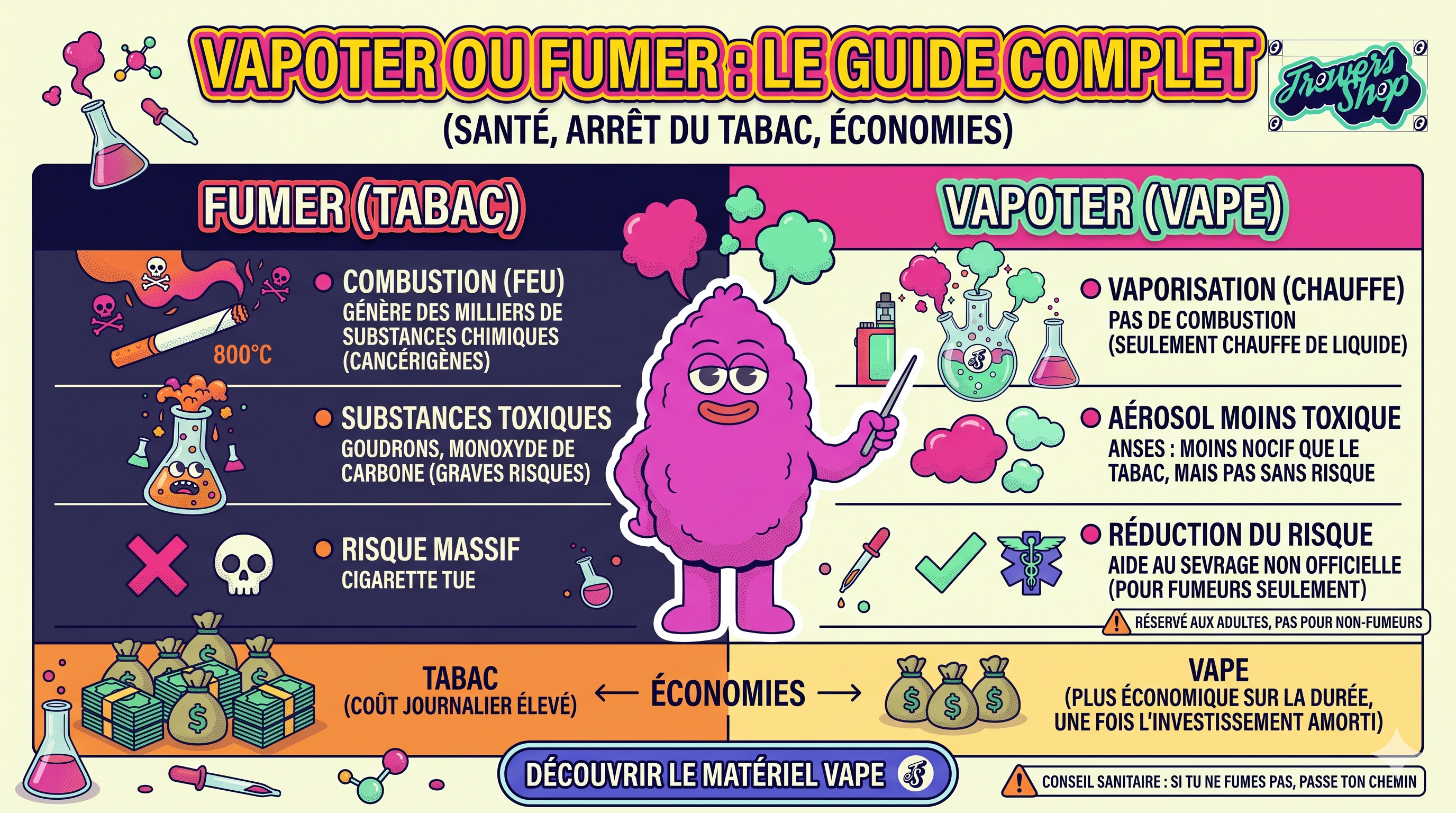
Vaping or smoking, the great debate. You hear everything and its opposite: "it's the same", "it's worse", "it's better". We'll set the record straight with what the health authorities actually say, no activism and no selling you dreams. The goal: that you understand where vaping sits compared to smoking, and that you make an informed choice. A quick note upfront: if you don't smoke, vaping isn't for you. This guide is aimed at adult smokers.
Is vaping less harmful than smoking?
This is THE question. And the answer from French health authorities is nuanced but clear: vaping is less harmful than smoking, without being risk-free. The ANSES report, the reference in France, confirms this lower harmfulness compared to the cigarette. But beware, "less harmful" doesn't mean "harmless": vaping is not a trivial act.
The logic is simple: cigarettes kill through combustion. When you burn tobacco, you generate thousands of chemical substances, dozens of which are carcinogenic. Vaping burns nothing: it heats a liquid to produce an aerosol. You therefore avoid combustion and most of the toxic substances it produces. That's the fundamental difference between the two.
Key takeaway: the real question isn't "zero risk or not", but "risk reduction compared to combustion". Tobacco presents proven, massive risks; vaping is not neutral but sits at a much lower level of harmfulness.
Combustion versus vaporisation: what really changes
To grasp the gap clearly, let's compare the two mechanisms side by side.
| Criterion | Cigarette | Vape |
|---|---|---|
| Principle | Combustion (fire) | Vaporisation (heating) |
| Temperature | Very high (800 C) | Moderate |
| Tar | Yes | No |
| Carbon monoxide | Yes | No |
Does vaping help you quit smoking?
Let's be honest and precise on this sensitive point. Many smokers use vaping as a transition tool, and many are satisfied with it. However, French health authorities remain cautious: to date, they consider that the scientific data are not sufficient to officially state that vaping is a validated aid for smoking cessation. The officially recognised methods for quitting tobacco remain nicotine substitutes and medical support.
Our position is therefore clear: vaping can be a risk-reduction choice for a smoker who can't quit otherwise, but it's not a miracle medicine. If your goal is to quit smoking, talk to your doctor or a tobacco specialist, who can support you with the tools suited to your situation.
The economic aspect: vape versus cigarette
Beyond health, there's the wallet. Over time, vaping generally works out far cheaper than smoking. Tobacco represents a daily cost that climbs fast over a month or a year. Vaping requires an upfront investment for the gear, then the cost is limited to e-liquids and coils. Many vapers notice substantial savings once the equipment is paid off.
Vaping when you don't smoke: bad idea
We insist, because it's important. The electronic cigarette is aimed at adult smokers, in a risk-reduction approach. If you don't smoke, there's no reason to start vaping: you'd expose yourself to risks (even if lower) with no benefit at all. Vaping isn't a health product, it's reserved for adults, and it only makes sense for someone seeking to move away from tobacco.
In short: where vaping sits
Vaping is less harmful than smoking because it avoids combustion and its toxic substances, but it's not risk-free for all that. It's also more economical over time. On the other hand, it's not officially recognised as a cessation method, and it's strictly reserved for adult smokers. If you smoke and are looking for an alternative, it deserves your attention; if you don't smoke, move along. To get started right, our guide and our selection of gear are here to point you in the right direction.