 Anglais
  Français
Shopping Cart
Everyone has an opinion about CBD. Your neighbour, your aunt at Christmas dinner, the guy at the bar who "knows a mate who". The problem is that 9 opinions out of 10 are wrong. So let's set the record straight, no nonsense and no treating you like a lab rat. Welcome to the only guide that actually explains what CBD is, why it isn't a drug, and how it has nothing to do with the stuff that makes your cousin laugh for three hours straight.
What is CBD, exactly?
CBD, or cannabidiol for those on first-name terms, is a molecule naturally found in the hemp plant. It's what we call a cannabinoid: a family of compounds the plant produces all by itself, no questions asked. There are over a hundred of them, but two hog the spotlight: CBD and THC. Remember those two, because the entire global confusion comes from people mixing them up.
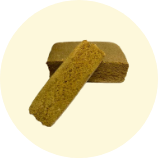
CBD is extracted from the flower and leaves of hemp, then turned into dried flowers, resins, oils, e-liquids or infusions. In short, it comes in every possible form to suit the way you consume. But whatever its final form: at its core, it's always the same molecule from the same plant.
Key takeaway: CBD is not a lab invention. It's a molecule nature has been making for far longer than humanity has been arguing about it.
Is CBD a drug?
No. And for once, we won't just tell you: we'll prove it using the official definition from the French government. According to the authorities, a drug is "any psychotropic or psychoactive substance that disrupts the functioning of the central nervous system (sensations, perceptions, moods, feelings, motor skills) or alters states of consciousness". Add to that a second criterion: a drug is "a product likely to cause physical and/or psychological dependence".
Two criteria, then: altering consciousness and creating dependency. And this is where it gets interesting, because CBD ticks neither box. It has no psychoactive effect: you don't get high, you don't see unicorns, and you remain perfectly capable of holding a coherent conversation (which, let's be honest, not everyone manages even stone-cold sober). And it creates no dependency. On the two conditions that define a drug, CBD scores a perfect zero. Case closed.
The government also sorts drugs into three families: those that soothe (alcohol, cannabis, opiates), those that stimulate (cocaine, ecstasy, amphetamines) and those that cause hallucinations (LSD, mushrooms). CBD belongs to none of these categories, for the simple reason that it produces none of these effects.
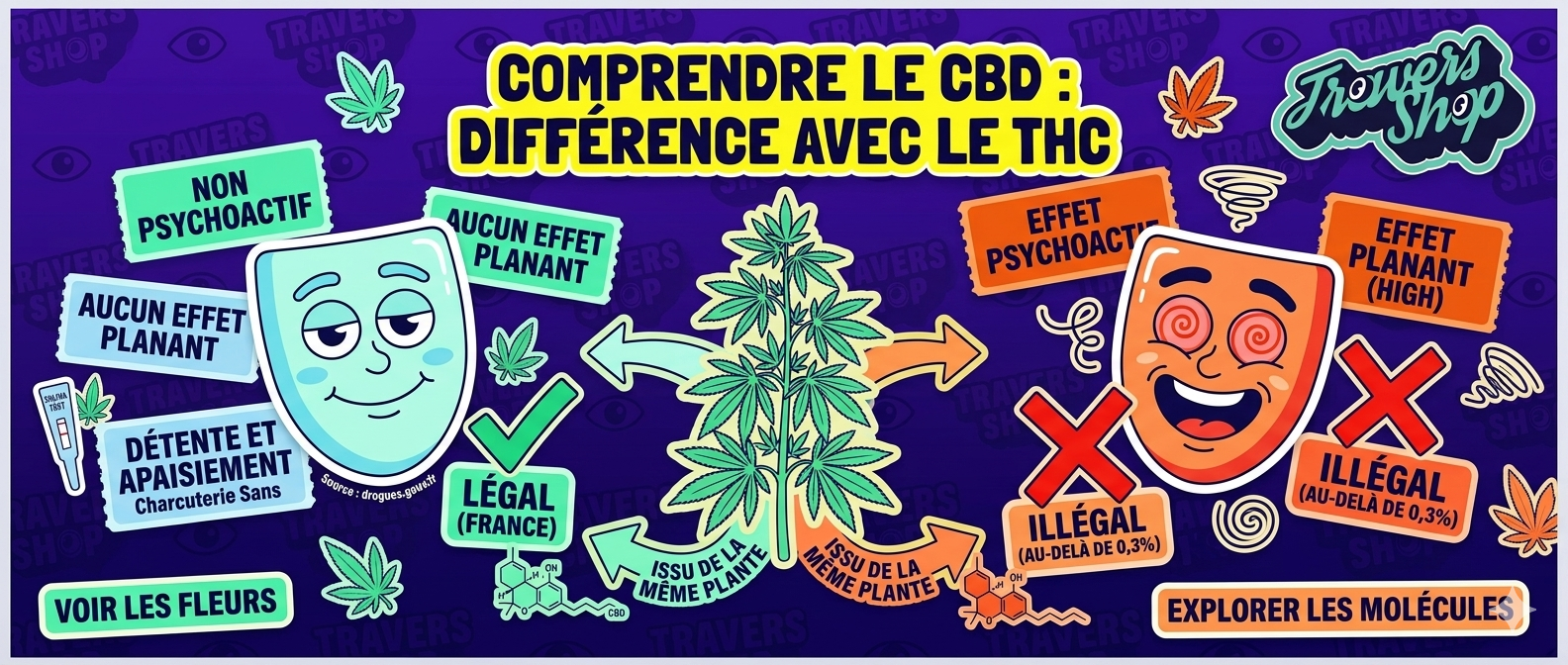
What makes "recreational" cannabis illegal and intoxicating is THC. That molecule is genuinely psychoactive and addictive: it ticks both boxes of the official definition. It's the one that triggers the famous "high", the altered perception and the dependency. CBD is the exact opposite. It's a bit like the difference between a herbal tea and a strong spirit: same botanical logic, but the effect on your brain is worlds apart.
Source: official definition available at www.drogues.gouv.fr
CBD vs THC: the difference that changes everything
If there's one paragraph to remember from this page, it's this one. CBD and THC are two cannabinoids from the same plant, but they act in radically opposite ways on your body.
Your body has a natural system called the endocannabinoid system. Picture a network of little receptors spread across your brain and body, mainly called CB1 and CB2. This system regulates lovely things like sleep, mood, appetite and the sensation of pain. Both CBD and THC interact with this network, but in completely different ways.
| Criterion | CBD | THC |
|---|---|---|
| Psychoactive effect | None | Yes, intoxicating |
| Legality in France | Legal (under conditions) | Illegal above 0.3% |
| Dependency | No | Yes |
| Sensation sought | Relaxation, calm | "High", euphoria |
In France, the law is clear on one point: a CBD product must contain less than 0.3% THC. Below that threshold, no high, no problem. This legal limit is what separates a wellness product from a narcotic. Every product you'll find at a serious retailer respects this cap.
Is CBD natural or chemical?
CBD itself is 100% natural: it's produced by the plant, full stop. Where it gets trickier is the extraction method. To pull CBD from the plant, several techniques exist, and they're not all equal.
The cleanest and most respected method is called supercritical CO2 extraction. Without subjecting you to an indigestible chemistry lecture: pressurised CO2 is used to separate the CBD from the rest of the plant, with no harsh chemical solvent and no toxic residue. It's the Rolls-Royce of extraction, the one that guarantees a pure product. Other methods use solvents, cheaper but potentially less clean. That's why CBD quality is also decided behind the scenes, not just on the label.
What is a CBD flower made of?
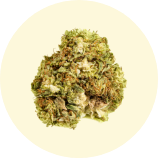
A CBD flower isn't just a block of cannabidiol. It's a complex botanical cocktail that obviously contains CBD, but also other minor cannabinoids (CBN, CBG and friends), terpenes (the molecules responsible for aromas and smells) and flavonoids. This whole little crew works together to create what's known as the entourage effect: the idea that the whole is more interesting than the sum of its parts.
This is precisely why a good CBD flower can't be reduced to its stated percentage. The richness of its composition, the quality of its cultivation and the care taken in drying make all the difference between an ordinary flower and an exceptional one.
Why do so many people get CBD wrong?
Because CBD has an awkward cousin. Since it comes from the same plant as recreational cannabis, many people lump them together out of pure reflex. Add years of media confusion, regulations that took their time getting clear, and you get the perfect fog for misconceptions.
The reality is simple, though: CBD is a wellness molecule, legal, non-psychoactive and non-addictive. The rest is just noise. And now that you've read this page, you officially belong to the group of people who know what they're talking about. Congratulations, you can now correct your neighbour with confidence.
In short: CBD is a natural cannabinoid from hemp, with no high and no dependency. THC is the psychoactive molecule that makes recreational cannabis illegal. Two molecules, same plant, different worlds.
Ready to put theory into practice?
Now that the theory is sorted, all that's left is to discover our products. Flowers, resins, molecules: everything is carefully selected and lab-tested. Knowledge is good. Knowledge with a good flower in hand is better.