


 Anglais
 Français
Shopping Cart
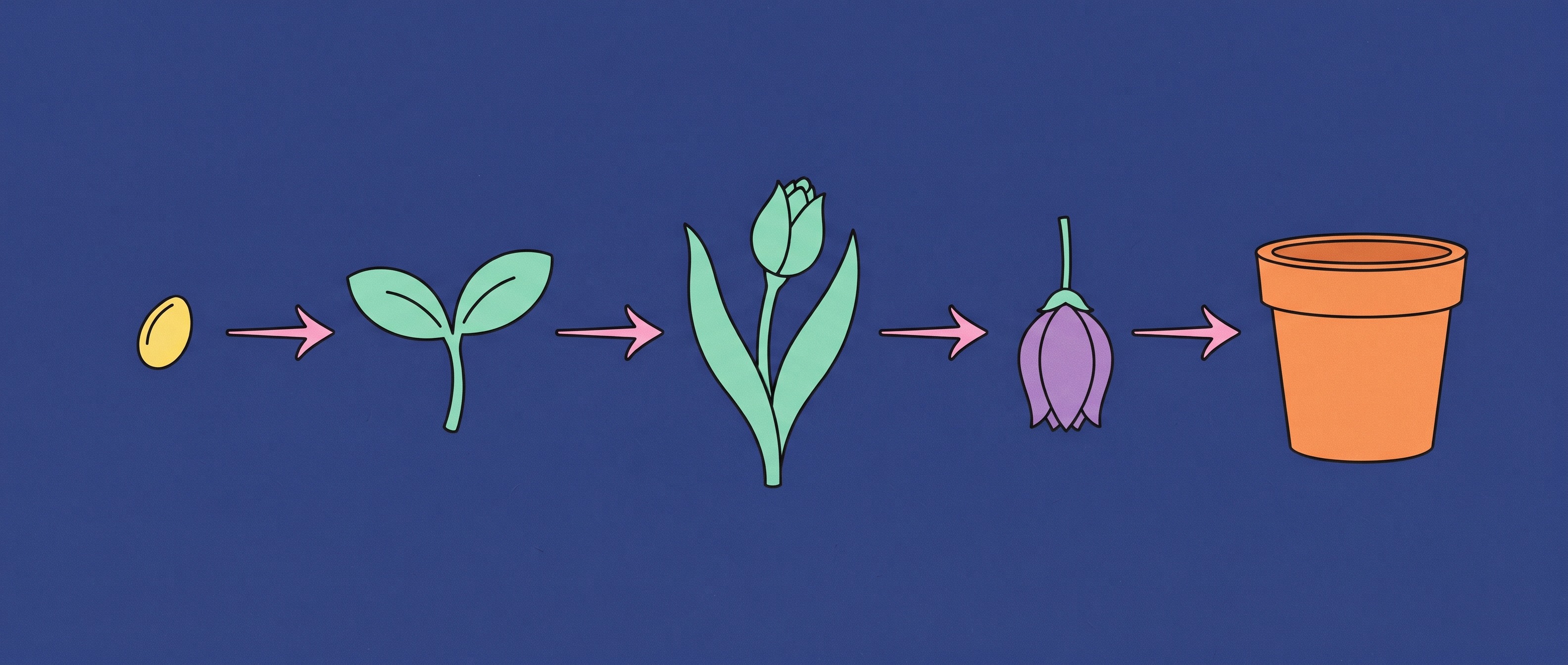
People talk a great deal about varieties and almost never about what happens to them next. A pity, because between two flowers carrying the same name, the quality gap rarely comes from the plant and nearly always from how it was handled.
This page follows the route in order: what may be grown, how it is grown, when it is harvested, what gets dried, and what gets transformed. At each stage, what changes concretely in the jar you receive.
One clarification up front: this describes how growers work, not how to go about it at home. Hemp cultivation is regulated and is not improvised in a cupboard.
The starting point: authorised hemp
It all begins with the seed, and not all seeds are equal in the eyes of the rules. Only varieties listed in the European catalogue of species and varieties may be cultivated, and the resulting flower must show a THC content below 0.3 %.
That threshold does not mean total absence: a hemp plant produces THC in small quantities, and the legal framework sets a ceiling rather than a zero. It is a nuance plenty of product pages flatten, and it matters. The framework is detailed in our page on the legality of CBD, and the difference between the two molecules in the one comparing CBD and THC.
The five growing methods
The growing method decides what the producer controls and what they endure. The more control, the more expense, and that equation alone explains the market's price hierarchy.
Outdoor
In open ground, under the sun. The least costly method and the most exposed: a wet season, a hailstorm or a heatwave reads straight into the harvest. Plants reach sizes indoor growing cannot allow, and yield per hectare is the highest of all.
In exchange, consistency between harvests is the weakest, and heads are generally less dense. This is a seasonal product in the literal sense.
Greenhouse
A tunnel, often plastic, sheltering from wind and rain while letting natural light through. The grower gains shelter and pays for structure, and can sometimes stretch the season by supplementing light.
It is the most widespread compromise in southern Europe: intermediate control, intermediate cost, and consistency markedly better than outdoor.
Glasshouse
The same principle under glass. The structure lasts longer, light transmission is better and thermal regulation finer than under plastic. The upfront investment, on the other hand, is in another league, which restricts this method to established operations.
Indoor
Inside, under artificial light, with temperature, humidity and light cycles steered from the first day to the last. The season ceases to exist: production runs year-round and conditions repeat exactly from one cycle to the next.
That control accounts for the density of the heads, the consistency between batches and the cost. Indoor consumes energy continuously, and it shows in the price per gram.
Hydroponics
A variant of indoor in which the plant grows without soil, its roots fed by a nutrient solution. The grower then controls nutrition too, parameter by parameter.
It is the most technical method and the least forgiving: an unbalanced solution shows within days. Few producers run it across a whole range, most keep it for a handful of varieties.
Which method to choose, and why the question is badly framed
There is no best method in the abstract, only a best method for a goal. If you want consistency and dense heads, indoor is beyond argument. If you want volume at a contained price, outdoor does exactly what is asked of it.
The shortcut to avoid is treating indoor as a guarantee of quality in itself. Badly run indoor cultivation gives a poor product that merely costs more. Conversely, well-managed outdoor across a good season is no by-product. The growing method describes a level of control, not a guaranteed result.
A season's calendar
Outdoors, planting happens in spring once frost is past, and flowering settles in at the end of summer as days shorten. Harvest follows, generally between late summer and mid-autumn depending on the variety, the region and that year's weather.
Indoors, that calendar disappears. Light cycles trigger flowering when the grower decides, allowing several harvests a year. Which is why an indoor flower reaches the market with no relation to the season, where an outdoor one follows the agricultural rhythm.
Harvest and trimming
Harvesting means cutting the plants, then separating them into branches. Trimming follows: the leaves surrounding the flowers are removed so that only the head remains.
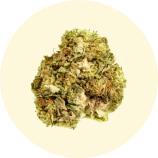
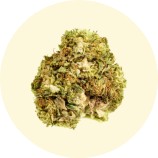
It is done by hand or by machine. Hand trimming is slower, costlier and markedly gentler on the resin glands covering the flower; machine trimming is fast and damages some of them. It is one of the places where a price difference is genuinely justified, and one of the few visible to the naked eye.
What comes off during that stage is not discarded: it is the trim, plant material then used for other products.
Drying then curing: the decisive stage
A freshly cut flower holds a great deal of water. Drying removes it slowly, away from light, in a ventilated and temperate room. Slowly, because drying too fast traps moisture at the core of the head and degrades the most volatile aromatic compounds.
Curing comes afterwards, and it is the stage almost nobody mentions. The flower is placed in sealed containers, opened regularly to let residual moisture escape. That slow maturation refines the aromatic profile and softens the finished product.
A badly dried or uncured flower stays recognisable: a flat smell, an unpleasant texture, sometimes a note of hay. It is by far the most common cause of disappointment on an otherwise well-grown product, and no analysis detects it, because an analysis measures molecules rather than craft.
From plant to resin
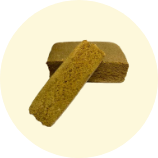
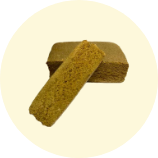
A resin is obtained by separating the resinous fraction from the plant material, then gathering it. Nothing is added: that is why a resin shows a higher percentage than a flower, since what diluted it has been removed.
Dry sieving is the oldest method: dried material is agitated above a screen that lets only the glands through. The result is a powder, pressed or not. Ice water sieving follows the same principle in a bath of water and ice, the cold making the glands brittle, with successive filtration sorting them by size.
Supercritical CO2 extraction belongs to another register. Carbon dioxide is brought to a state where it behaves as both liquid and gas, passes through the plant material, extracts its compounds, then evaporates entirely on returning to ambient pressure. No solvent residue, fine control over what is extracted, and equipment that costs a great deal. It is the reference process for extracts destined for oils.
Cold pressing, finally, crushes the material mechanically without heat or solvent. Yield is low, the process simple, and the result preserves fragile compounds well. Other methods use solvents such as ethanol, effective but requiring a solvent-removal step that the analysis must account for. Every resin in the catalogue sits in the resin and wax category.
Additives, solvents and flavourings
The subject is rarely raised, which is precisely why it deserves a section. Some products on the market receive artificial flavourings, colourings or preservatives, or retain residues of the solvent used for extraction.
None of that is reliably visible or detectable by smell. A very pronounced and perfectly uniform smell across a whole batch should draw attention, but it is only a clue. The only serious verification remains the laboratory analysis, and our page on choosing and storing CBD explains how to read one.
A product enriched with a molecule after harvest follows a different logic again, covered in our page on synthetic molecules.
A concrete example: CBD First
CBD First is a French family business based in Limoges, for which we are an official reseller. Its flowers are grown mostly in Italy and partly in France, under mostly indoor cultivation, with a few varieties run hydroponically.
That spread is fairly representative of serious practice on the European market: an indoor base for consistency, Italian production for the climate and the sector's head start, and a few trials on more technical methods. The ranges sit in the CBD flower category, from Amnesia Maxi First to Lemon Kush by way of Amnesia Candy Pop First.
Frequently asked questions
How can I tell how a flower was grown?
The product page should say. If it does not, that is one less piece of information to judge by, and the question is worth putting to the seller. A grower working indoors mentions it, because it is their argument.
Is an outdoor flower less compliant?
No. Compliance is measured by THC and verified by analysis, not by growing method. A compliant outdoor flower is exactly as compliant as a compliant indoor one.
Why do two batches of the same variety differ?
Because a plant is not a machine. The season, the way cultivation was run, the precise moment of harvest and the drying each contribute their share of variation. Indoor narrows that gap, it does not close it.
Going further
The cannabinoids the plant produces naturally are detailed in our page on CBN, CBG and CBC. And if you would rather judge a product than believe a description, three checks cover it: the origin and growing method, a laboratory analysis dated and tied to a batch, and the look of the head, which tells you more about trimming and drying than any description will.