
 Anglais
  Français
Shopping Cart
A Comparison of Cultivation Methods: Indoor, Greenhouse, Outdoor, and Hydroponic CBD
So, you’ve finally decided to ditch the wonderful world of chemical anti-anxiety meds that turn you into a mindless zombie to try CBD instead? Good for you. But before you pounce on the first pouch you see like a starving walker on fresh brains, you need to understand one thing: not all flowers are created equal. In the magical world of hemp, a plant’s birthplace determines whether you’re about to experience absolute relaxation or feel like you’re smoking the remains of a pet cemetery. Choosing between Indoor, Outdoor, Greenhouse, or Hydroponics is a bit like choosing between a five-star palace, a leaky tent in a rainstorm, or a mad scientist’s laboratory. Each method has its perks, its flaws, and its share of disappointment for cheapskates who think a plant grown in the mud will taste like a beauty queen raised on a silver platter. Let’s be real: if your budget looks like that of a philosophy student, your lungs are going to feel the burn. But don’t worry, we’re here to stop you from flushing your precious cash down the drain on greenery that has more in common with your grandma’s lawn than an actual high-quality flower.
The debate is often heated between the purists and the wallet-watchers. On one side, we have the "all-natural" crowd—those who believe that if a plant hasn't survived a locust plague and three hailstorms, it has no soul. On the other side are the cultivation technocrats, who want to control every photon and every drop of water to produce a flower so perfect it’s almost intimidating. In the middle, the average consumer (that’s probably you) is just trying not to get scammed by pompous marketing terms. The quality of a CBD flower is intrinsically linked to how it’s produced. The environment forges the plant's character, its aromas, its cannabinoid concentration, and—incidentally—the pleasure you’ll take in not coughing your lungs up on the first try. If you mess up your choice of cultivation style, you might end up with something that smells like a damp closet or has the texture of a biscuit forgotten since 1994. So, grab onto your sofa; we’re diving into the bowels of production to see which bud actually deserves to end up in your vaporizer or tea (because combustion is strictly for people who have already pre-booked their spot at the crematorium).
Pros and Cons of Indoor CBD Flowers for Superior Quality
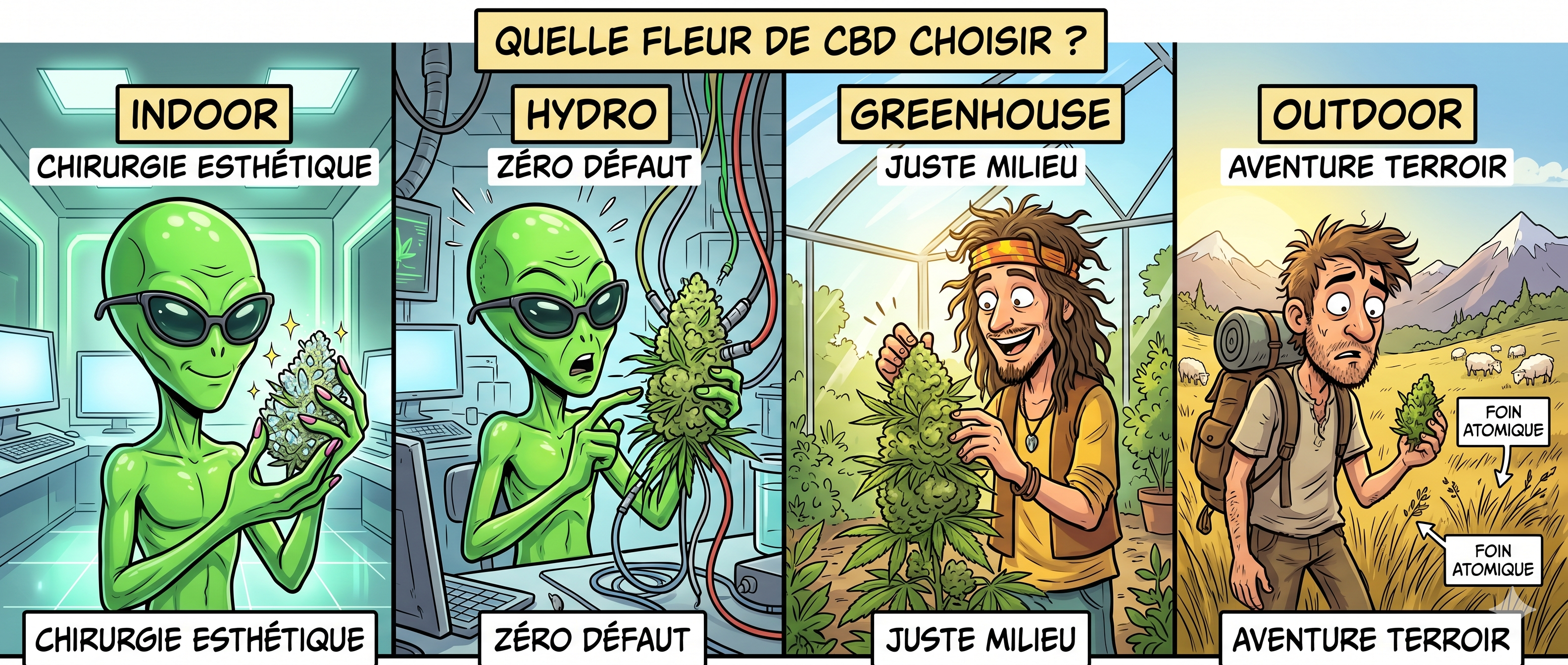
Indoor is luxury, calm, and pure indulgence. Imagine a plant raised in an ultra-secure bunker, bathed in artificial light more powerful than the July sun, with the temperature regulated to the nearest thousandth of a degree. Here, there’s no rain, no bugs, no annoying neighbors—just technological perfection serving your high... well, your legal relaxation. Indoor flowers are the supermodels of the market: they are dense, ultra-resinous, covered in trichomes that sparkle like diamonds in the dark night of your existence, and their aromas are so complex they could make a sommelier weep. This is the choice for those who don’t joke around with quality. By controlling everything from A to Z, growers eliminate luck from the equation. The result? Optimized CBD levels and a terpene profile that explodes in your mouth. It’s the guarantee of a "clean" product, without nasty surprises, caked-on dirt, or pesticides (ideally, unless the grower is a psychopath). If you have the means and you consider your lungs a temple rather than a local landfill, Indoor is where you go without a second thought.
However, it’s not all sunshine and rainbows in the land of LED lamps. The first drawback, and it’s a big one, is the price. Raising plants in a five-star hotel with AC and electricity running 24/7 is expensive, and you’re the one footed with the bill. If your bank account is already on life support, buying Indoor CBD might just deliver the final blow. Then, there’s the ecological aspect. Let’s not kid ourselves: burning thousands of kilowatts so you can unwind after your office job isn't exactly "saving the planet." But hey, between saving the polar bears and saving your own mental health, we all know which one you’re prioritizing. Another potential "issue" is that these flowers are sometimes so powerful and rich they might seem artificial to those nostalgic for the wild weed of the 70s. But honestly, who wants to smoke weed that tastes like potting soil when you can have a flavor explosion of fruit or cream? Indoor remains the absolute gold standard, and once you’ve tasted it, everything else will feel pretty bland—sort of like moving from Kobe beef to a freezer-burned burger found at the bottom of a broken fridge.
Why Choose Greenhouse Cultivation for the Best Value for Money?
Greenhouse cultivation is the smart compromise. It takes the best of both worlds: natural sunlight (because it’s free and gives the plant a certain "soulful" strength) and the protection of a roof (because bad weather is for losers). In a greenhouse, the plant enjoys daylight but stays safe from wind, hail, and massive pest attacks. It’s the upper-middle class of CBD. You get very high-quality flowers, often larger in size than Indoor ones, with authentic aromas and great structure. It’s the ideal choice for someone who wants quality without having to sell a kidney on the black market. It avoids extremes: it’s not as pricey as Indoor, but it’s far more qualitative than basic Outdoor. For many, this is the "sweet spot," where you find the best value for money in CBD. You get the entourage effect, the terpenes are well-represented, and visually, it’s still very flattering. This is the everyday bud—the one that keeps you company without bankrupting you or making you feel like you’re consuming a generic store-brand knockoff.
But be warned: a "compromise" also means you aren't touching absolute perfection. The quality of a Greenhouse bud can vary wildly from one grower to another. If the greenhouse is rudimentary, you’re at the mercy of natural cycles: a terrible summer will yield a mediocre harvest, period. You don't have the surgical control of Indoor. Sometimes the flowers are a bit less dense, a little less crystalline, and the aromatic profile might lack that almost supernatural subtlety found in lab-grown flowers. This is a plant that has seen the sky, felt the seasons pass, and you can tell. It’s more "real," sure, but sometimes less spectacular. If you’re an aesthete who spends your time inspecting buds under a microscope to count trichomes, you might be slightly underwhelmed compared to a top-tier Indoor. But if you’re just looking to decompress after work with a healthy, effective, and tasty product, Greenhouse is your best ally. it’s the promise of honest pleasure without the fluff, respecting both your neurons and your survival budget in a hostile urban environment.
The Specifics of Outdoor CBD Flowers and Hydroponics
Now let's talk about Outdoor, or open-air cultivation. This is the ancestral way, the way of our forefathers who didn't have electricity bills to worry about. Here, the plant is left to its own devices against a wild and unforgiving nature. It has to fight off storms, heatwaves, hungry insects, and opportunistic fungi. This permanent stress builds a robust plant, but the final result is often... rustic. Let’s not beat around the bush: visually, Outdoor often looks like something you’d find stuck under a lawnmower. The buds are airier, darker, filled with small leaves, and maybe even a few seeds if a male plant wandered into the area. But wait, don't throw stones at Outdoor too quickly. This is where you find the earthiest, woodiest, most "wild" aromas. It’s the CBD of the soil purists, the nature lovers who want to taste the terroir. Most importantly, it’s the cheapest CBD on the market. If your goal is to make bulk infusions or your own oils without going broke, this is the logical choice. It’s raw, it’s gritty, and it’s perfect for those who don’t care about aesthetics as long as the molecule is there to do its job.
At the other end of the technological spectrum, we find Hydroponics. Here, we forget about dirt, mud, and romance. We’re in Minority Report territory. The plant roots sit directly in a solution of water and ultra-dosed nutrients. It’s Indoor on steroids. Since there’s no soil to act as a buffer, the plant absorbs everything you give it instantly. Growth is lightning-fast, and the flowers reach levels of purity and density that defy the laws of physics. The taste is often clinically clean, almost too perfect. Hydroponic CBD flowers are for those seeking pure performance—an immediate explosion of flavor without any earthy aftertaste. It’s the pinnacle of human mastery over vegetation. But this perfection comes with a price: it’s complex to produce, requires constant monitoring (one pump failure and the whole crop dies in three hours), and is often the most expensive product. It’s like the Formula 1 of CBD: it’s magnificent and powerful, but it’s not necessarily what you want to drive to pick up groceries every morning. Between the ruthless wild of the Outdoor and the robotic perfection of Hydroponics, your heart (and especially your wallet) will have to make a tough call.
Choosing the Right Cultivation Method for Your Desired Effects
Now that you understand the difference between a plant grown in a lab and one that survived a hurricane, the question remains: what do YOU want? If you’re looking for a powerful relaxing effect to forget that your existence is a seamless sequence of disappointments, head toward Indoor or Hydroponics. The concentration of active ingredients is generally more stable and higher. These flowers are ideal for evenings when you just want to melt into your sofa and think of nothing, not even the dishes that have been sitting there for three days. The sensory pleasure is at its peak, and the experience is premium from start to finish. It’s the choice for immediate effectiveness and absolute comfort. You don't mess around with relaxation when you're paying for high-tech performance. This is also the best choice for those using CBD for therapeutic reasons who need unwavering consistency in their product quality, as each batch is practically identical to the last thanks to total environmental control.
If you’re more of the "nature and discovery" type, or if you simply like the idea of consuming a product that didn't require the power consumption of a small provincial town, Greenhouse or Outdoor CBD is for you. Outdoor is excellent for long infusions, where earthy flavors pair well with other herbs. It’s a more subtle, authentic pleasure that sometimes requires appreciating the ruggedness of the product. Greenhouse, meanwhile, is perfect for regular consumption throughout the day without eating through your life savings. It offers a perfect balance for those who want to stay functional while smoothing over the edges of their chronic anxiety. Ultimately, the choice depends on your philosophy: do you want an "artificially perfect" experience or a "natural imperfection"? There is no wrong answer, only different budgets and varied sensitivities. The important thing is knowing what you put into your body, because even if it’s legal, that’s no excuse to consume trash—especially when some people sell hay sprayed with chemicals as if it were green gold.
The Importance of Origin and Soil Quality
It doesn't matter if you choose Indoor, Outdoor, or Greenhouse; there’s one thing you must never forget: hemp is a sponge. It soaks up everything. If the soil is polluted with heavy metals, if the water is full of industrial runoff, or if the grower was heavy-handed with pesticides because they were scared of a tiny spider mite, you’re going to end up consuming all of that. This is where CBD traceability becomes vital. At Travers-Shop, we don't mess around with this. We’d rather have an Outdoor flower grown in healthy, living soil than an Indoor flower grown with shady nutrients in a dingy warehouse. The quality of the soil (or nutrient solutions in hydro) determines the purity of your moment of zen. A healthy plant yields a healthy flower. A stressed or poisoned plant will give you... a headache and a monumental disappointment. This is the foundation of everything. Before looking at the CBD percentage, look at where the plant came from. Is it from an eco-responsible farm in Europe or an obscure industrial site on the other side of the world?
Finally, never forget that the best test is your own nose. A quality flower, regardless of how it was grown, should smell "real." If it smells like hay, mold, or worse, has no smell at all, something went wrong during the growing or drying (curing) phase—that crucial step amateurs often forget. Choosing your CBD flower is about learning to trust your senses. Visuals matter, smell is paramount, and the final effect is the ultimate judge. Don't let shiny packaging or promises of insane CBD percentages intimidate you. Stick to the basics: controlled cultivation, a transparent producer, and a flower that speaks to you. And if you’re still hesitating, get a little of each and run your own home laboratory. After all, life is too short to smoke bad weed, even when it’s legal. Go on, make your choice, relax, and try not to forget to turn off the lights on your way out—the planet will thank you (especially if you chose Indoor).