




 Anglais
  Français
Shopping Cart
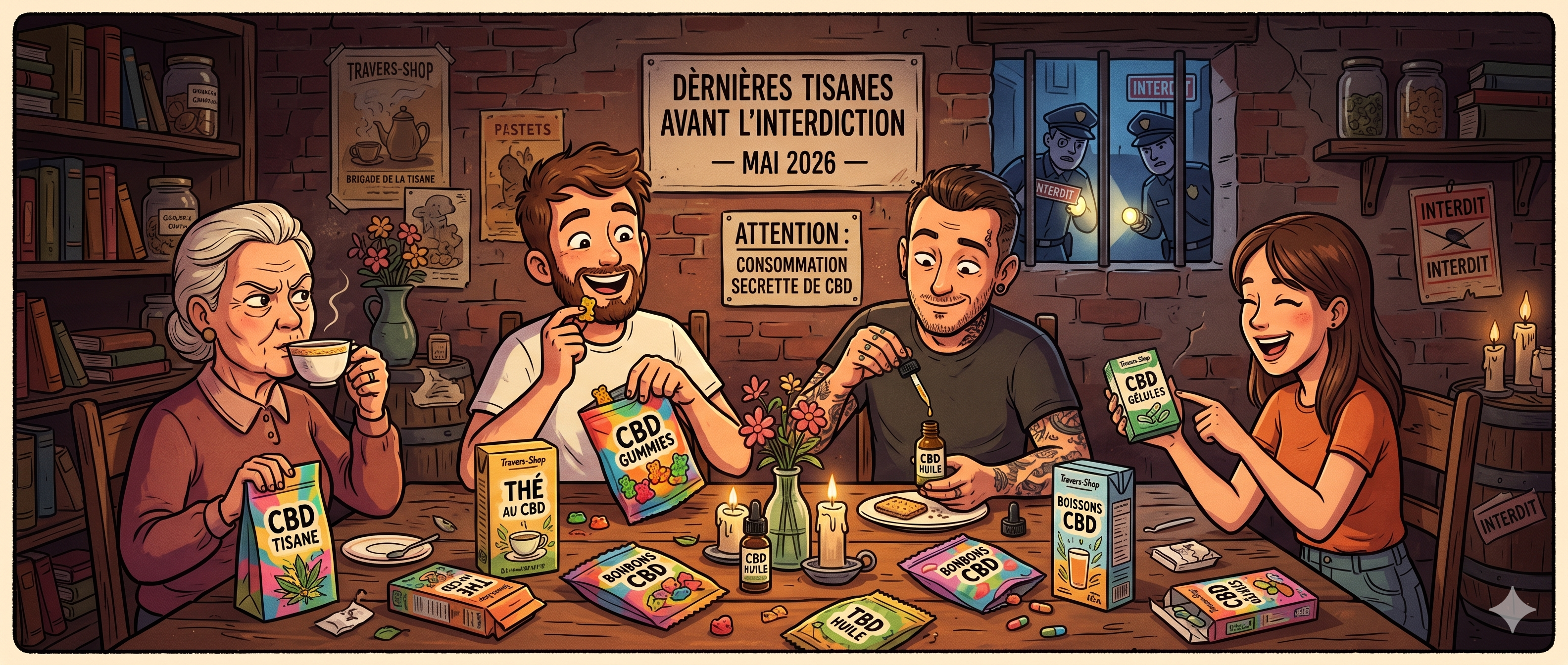
The ban on CBD food products in France starting May 15, 2026
So, there it is. The axe has fallen, and it’s as sharp as a guillotine on a foggy morning at the Place de la Concorde. Starting May 15, 2026, the State has decided that your stomach is a protected zone, a sacred sanctuary where cannabidiol no longer has the right of citizenship. Forget the little treats, end the evenings quietly steeping your flowers while thinking about world peace. Pack up the jars, clear the shelves, and psychologically prepare yourselves for a return to digestive austerity worthy of the finest hours of wartime rationing. At Travers-Shop, we’ve always loved being offbeat, but here, we’re bordering on bureaucratic genius: turning millions of relaxed gummy consumers into gelatin outlaws overnight. It’s almost poetic, if you ignore the fact that your evening herbal tea officially becomes as subversive as trafficking enriched plutonium. We can already imagine the specialized squads, sniffing out the suspicious scent of hemp-enriched chamomile at retirees' homes in the countryside. It’s a great day for order, morality, and probably for the sellers of heavy chemical sleeping pills who were starting to worry about people sleeping naturally without feeling like a zombie the next morning. Savor your last crumbs, because the feast is over.
This radical decision pulls no punches. We aren’t talking about a simple regulation or stricter labeling to protect our dear little ones who might mistake a CBD candy for a gummy bear. No, it’s a pure and simple eradication of the food branch of the CBD range. Gummies, infusions, drinks, capsules, and even that poor CBD oil you lovingly placed under your tongue... it’s all going down the drain. One wonders what mortal danger was lurking for the population. Perhaps the fear of an epidemic of overly relaxed people, capable of enduring train delays with a beatific smile? Or the risk of seeing national stress drop to such a level that the anti-anxiety industries would go bankrupt, putting thousands of lobbyists out of work? Whatever the case, the legislator has spoken: eating CBD is over. You can still look at your favorite products with nostalgia before throwing them in the fire (don’t actually do that, the smoke might make you a little too happy, and that’s frowned upon these days). We are entering an era of gastronomic prohibition where simply chewing a relaxing gum makes you look like public enemy number one.
Impact of the new regulations on the sale of cannabidiol infusions and beverages
The beverage and herbal tea sector is taking a sledgehammer to the back of the neck, and we’re not talking about a minor temporary headache. For all those who swapped their tenth coffee of the day for a hemp infusion to avoid ending up like a live wire at 11 PM, it’s back to square one. CBD drinks, whether sparkling, still, or flavored, are disappearing from the shelves with the grace of a convict walking to the scaffold. It’s a true first-class funeral for an industry that was just beginning to bloom. Why ban what allowed people to decompress without ending the night with their head in a bucket after three pints of beer? It’s the great mystery of our time. We apparently prefer that you destroy your liver the old-fashioned way rather than letting your endocannabinoid receptors play with plant molecules. May 15, 2026, will mark the beginning of an era of liquid sadness, where plain water will be your only ally against existential dread. The "well-being" aisles in stores will look like post-apocalyptic deserts, emptied of any substance capable of bringing a minimum of comfort to a population already battered enough by the news. It’s a bold political choice: cut the tea to make sure everyone stays tense, nervous, and above all, reactive to the slightest micro-aggression of daily life.
The remaining stocks of hemp tea will become relics, collector’s items traded under the table in underground parking lots. We can already imagine the headlines: "International Verbena-CBD ring dismantled." It’s consummate ridicule, but it’s our reality. The law is the law, even when it seems to have been drafted by a committee of people who haven’t felt the need to relax since 1984. What’s fascinating is this desire to standardize pleasure by making it as bland as possible. If it’s not alcoholic or stuffed with sugar, it apparently no longer has a place in your throat. Merchants, for their part, are left to cry over their unsold stock or turn it into luxury compost for their geraniums. Because after the fateful date, possessing a can of CBD lemonade will undoubtedly be seen as a major act of rebellion, a direct insult to public order and mandatory sobriety. It’s the triumph of suspicion over common sense, an ode to administrative paranoia that prefers to burn the field rather than learn how to manage the harvest. Enjoy your last cups, because soon, the only way to get high will be watching gas prices soar.
The end of CBD gummies and candies: consequences for consumers and retailers
Let’s talk about gummies. Those little colored bears that did so much for your morale and so little harm to those around you. They are now the pariahs of the food industry. Starting mid-May, the sale of any candy containing CBD is strictly prohibited. It’s the end of an era of sweetness. We imagine the government feared we would all become too "soft," unable to produce the growth necessary to feed the economic machine. Or maybe they just decided that pleasure should be punitive. Specialized retailers find themselves with kilos of gummies on their hands—products they paid for, gave passionate advice on, and which are today considered toxic waste by the magic of a decree. It’s a tragedy for small businesses, a middle finger sent to those who invested in a green and peaceful economy. We’re killing the business to save... what exactly? The purity of the candy aisles? It’s a joke that only makes those who don't risk bankruptcy laugh. The consumer, meanwhile, loses their favorite method for managing stress discreetly and effectively. From now on, you’ll have to settle for biting your nails or smoking cigarettes (that’s legal, encouraged by taxes, and healthy for the State's coffers).
The psychological impact is not to be ignored. We are taking away an emotional management tool from people under the pretext of food safety, while leaving products on the open market whose ingredient lists look like a heavy chemistry lab inventory. It’s a hypocrisy that borders on the sublime. We punish CBD because it comes from a plant that causes trouble, because it carries the shadow of its forbidden cousin, THC. It’s a form of guilt by association hitting a molecule that is otherwise harmless. CBD candies are disappearing, taking with them the promise of easy and accessible relaxation. What remains is frustration and incomprehension in the face of legislation that seems to be standing on its head. We’re told it’s for our own good, as if we were children incapable of knowing what we put in our mouths. The message is clear: your body doesn’t really belong to you; it belongs to the administration that decides what is good for your serenity. If you want to be zen, do yoga, breathe incense, but for pity's sake, stop chewing those things that actually work. It’s too dangerous to let people feel okay by their own means.
The ban on CBD oil and capsules: toward a total restriction of oral consumption
This is undoubtedly the hardest blow for those who used CBD for daily well-being. CBD oil, that magic bottle that allowed people to regulate sleep, calm pain, or simply avoid the urge to bite their office neighbor, is now banned from human consumption. CBD capsules, so practical for precise dosing, suffer the same fate. We are told it is no longer a food product. So what? Are we supposed to use it as bicycle chain lubricant? As massage oil for our pets’ feet (provided they aren’t banned too)? It’s total nonsense. We are depriving thousands of people of a food supplement that had proven itself, without any credible alternative other than the classic pharmacopoeia, which is often much more aggressive. It’s a brilliant victory for the proponents of "all-chemical," those who prefer to see a prescription for benzodiazepines rather than a bottle of cold-pressed vegetable oil. May 15, 2026, will be etched in stone as the day natural products definitively lost the war against the administrative stamp.
Hypocrisy reaches its peak when you realize these products had been sold legally for years, with extremely positive customer feedback. But no, suddenly, a light went on in a ministry office and decreed that oil was a threat to public health. We don’t know which threat, we don’t know why, but it’s forbidden. That’s the beauty of bureaucracy: it doesn’t need proof when it has the power to destroy. Regular users will have to turn to the black market or order from abroad, taking risks they should never have had to take in a civilized society. We are creating delinquency where there was only a search for comfort. It’s a masterpiece of counter-productivity. At Travers-Shop, we watch this spectacle with a mix of disgust and bitter irony. We are asked to be serious, to give advice, but how do you advise people when the law changes faster than the weather in Brittany? We can only witness the damage and tell ourselves that, decidedly, humanity has an incredible talent for making life complicated. Oral CBD is dead; long live stress, sleepless nights, and nervous breakdowns. That’s probably what progress looks like.
Timeline and implementation of the new prohibitions on hemp products
Mark this date in red, or better yet, with the blood of your last CBD flowers: May 15, 2026. This is the "D-Day" of modern prohibition. After this date, any CBD-containing food product found on shelves could lead to sanctions worthy of a Colombian cartel (we only slightly exaggerate). Inspections will pour in, fines will drop, and stock destructions will be organized. It’s a purge. Authorities have planned a tight schedule to ensure no one slips through the cracks. We aren’t joking about health anymore (or the idea they have of it). If you were hoping for a transition period, a grace period to sell off your infusions, forget it. The administration has a short memory when it comes to business, but it has a very long arm for enforcing its new whims. We are preparing for surprise inspections in specialized shops, as if we were tracking meth labs in "Breaking Bad." All this for hemp seed oil and a few milligrams of cannabidiol. It’s grand.
The application of this law will transform the CBD landscape in France. What was a dynamic and innovative industry will become a field of food ruins. We will have to reinvent ourselves, find other ways to offer the benefits of this plant without going through the stomach. But for now, it’s a shock. We see entrepreneurs who bet everything on this sector finding themselves high and dry. This is the dark side of commerce: being at the mercy of a signature at the bottom of a decree. May 15th is tomorrow. It’s time to stock up if you want to hold out, or to mourn if you are the type to respect laws, even the most absurd ones. At Travers-Shop, we stand here, watching the ship rock, with our usual humor because honestly, if we don’t laugh about it, we’ll end up biting people. And without CBD to calm us down, that might hurt. Prepare for the great void, because the party is over and the State is the one picking up the glasses (empty of infusion, obviously). We’ll meet on the other side of prohibition, probably a little more tired, a little more tense, but with the satisfaction of having lived through the last years of food freedom for this poor molecule. Rest in peace; it tried to relax us, and that was its greatest crime.