


 Anglais
  Français
Shopping Cart
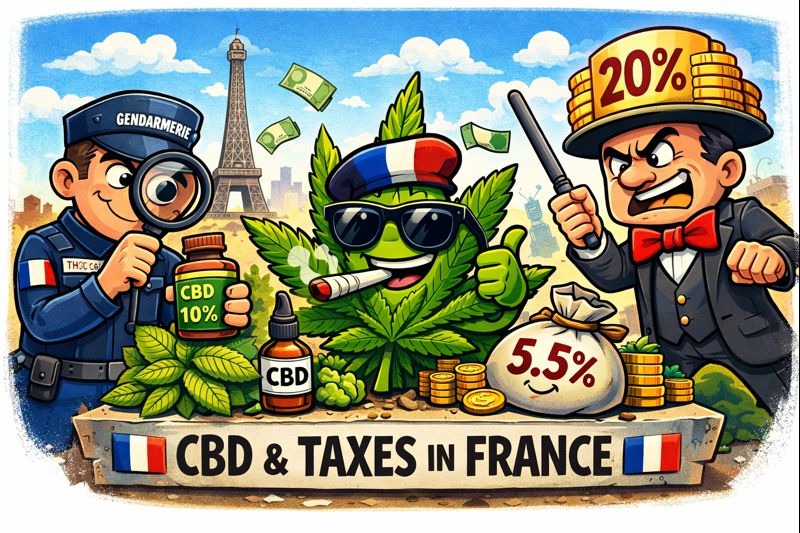
Understanding CBD legislation in France: rules, THC below 0.3%, CBD levels and VAT under debate
CBD has long moved beyond being a curiosity to become an everyday product: oils, infusions, flowers, resins, cosmetics… But as soon as we talk about buying, selling, transporting or consuming it, one question always comes back: what does CBD legislation in France really say? And above all, what is currently changing on the tax side, with this sensitive issue of a VAT rate that could evolve next year?
In this article, we will clarify what is allowed today, what the rule of THC below 0.3% actually means, how to read a CBD level, and why CBD VAT is at the heart of an ongoing budgetary debate that is far from being settled. To explore CBD products that comply with French regulations, you can also discover the selection here: https://www.travers-shop.com/fr/8-CBD
CBD: legal or illegal? The simple answer
In France, the sale and consumption of non-medical CBD are authorised, provided that a strict framework is respected. The French Ministry of the Economy provides official guidance and resources to better understand this framework, which is an essential reference to avoid approximations. https://www.economie.gouv.fr/cedef/fiches-pratiques/comment-est-encadree-la-vente-de-cbd-cannabidiol
The core issue lies in the distinction between CBD and THC. CBD is sought for well-being purposes, while THC is the molecule associated with psychoactive effects. This is precisely why the law strictly regulates the level of THC authorised in hemp-derived products.
The key rule: THC below 0.3% and what it really implies
You often see the mention THC below 0.3%. This threshold has become a central reference point: it is used to distinguish products derived from low-THC hemp from those considered narcotics. At the end of 2022, the French Council of State definitively overturned the ban on the sale of hemp flowers and leaves when THC is below 0.3%, stressing that CBD has no psychoactive effects and does not cause dependence.
In practical terms, this limit means two important things for consumers:
1) A compliant product is designed to remain below this threshold, but this does not exclude controls, laboratory analyses and regulatory requirements related to labelling and traceability, depending on the product category.
2) The threshold applies to THC, not CBD: a product can display a high CBD level and still be legal, as long as THC remains below 0.3%.
Reading a CBD level: understanding what you are buying
The CBD level is often the most visible piece of information on a product sheet, but it can be interpreted differently depending on the form:
- For oils, a percentage (e.g. 10%, 20%) indicates the concentration in the bottle.
- For flowers or resins, a CBD percentage generally corresponds to the measured content in the plant material or extract.
- For infusions, the value depends on the blend (hemp, plants, flavourings) and the actual amount extracted during infusion.
What you should remember is this: the CBD level gives an indication of potential intensity, but it does not say everything about quality. To compare products properly, you can check the extraction method, the origin of the hemp, and the availability of laboratory analyses.
CBD VAT: why do we talk about 5.5% and 20%?
VAT is a real headache, because taxation may vary depending on the product category and its intended use. One thing is clearly stated in public information: products presented as smokable fall under the standard VAT rate of 20%, not a reduced food-type rate. This is a crucial point, as certain presentations (herbal teas, pot-pourri) may be scrutinised if they appear to be intended for smoking.
At the same time, there has been ongoing debate for several years about the application of a reduced 5.5% VAT rate to certain CBD products assimilated to food or herbal infusions. Some industry players have highlighted these differences and their economic impact, even though caution is required, as tax treatment may vary depending on the exact nature and classification of the product.
Why a potential increase to 20% is causing concern
If a reform were to extend the 20% standard rate to a broader range of CBD products, the consequences would be immediate:
- For consumers: higher prices, new trade-offs, and potentially reduced accessibility.
- For specialised shops: pressure on margins, adjustments to product ranges, and increased competition from less compliant actors.
- For the market as a whole: a risk of pushing some demand toward unregulated channels, which would run counter to safety and transparency objectives.
In other words, this debate is not only fiscal. It is also economic and linked to public interest, as it conditions the ability of the legal market to remain competitive and compliant.
Budget and political timeline: where things stand today
You mentioned a Senate vote in favour of a tax increase, followed by the next steps involving a joint parliamentary committee and the National Assembly. From an institutional standpoint, the key takeaway is this: the budget bill follows several stages, and a vote in the Senate alone is not sufficient to make a measure final or automatically applicable.
The legislative process continues with negotiations, possible amendments and compromises, before any final vote. As a result, the final outcome may differ in scope, timing and application from what was initially proposed.
How to prepare intelligently for possible tax changes
Whether you sell or consume CBD, the goal is not to panic, but to anticipate responsibly:
- For consumers: monitor regulatory developments, favour transparent retailers, and keep purchase receipts if needed.
- For e-commerce businesses: structure product pages with clear information (category, intended use, analyses), and prepare for rapid updates if VAT rates change.
- For SEO strategy: update content as soon as a final decision is made, since search engines value up-to-date legal information.
Key takeaways: CBD legislation, THC below 0.3% and VAT
If you need a simple summary:
- CBD legislation in France authorises the sale of non-medical CBD within a defined legal framework, supported by official public resources.
- The most well-known rule remains the THC below 0.3% threshold, which is a major legal benchmark.
- The CBD level indicates concentration but must be interpreted according to the product form.
- In terms of VAT, smokable CBD products clearly fall under the 20% standard rate, while debates and uncertainties remain for products assimilated to food or infusions.
- The budgetary discussion is still ongoing: a Senate position does not close the process, and the final decision will depend on further parliamentary steps.
You can now explore the CBD category on Travers-Shop and focus on clear, compliant and well-presented products: https://www.travers-shop.com